
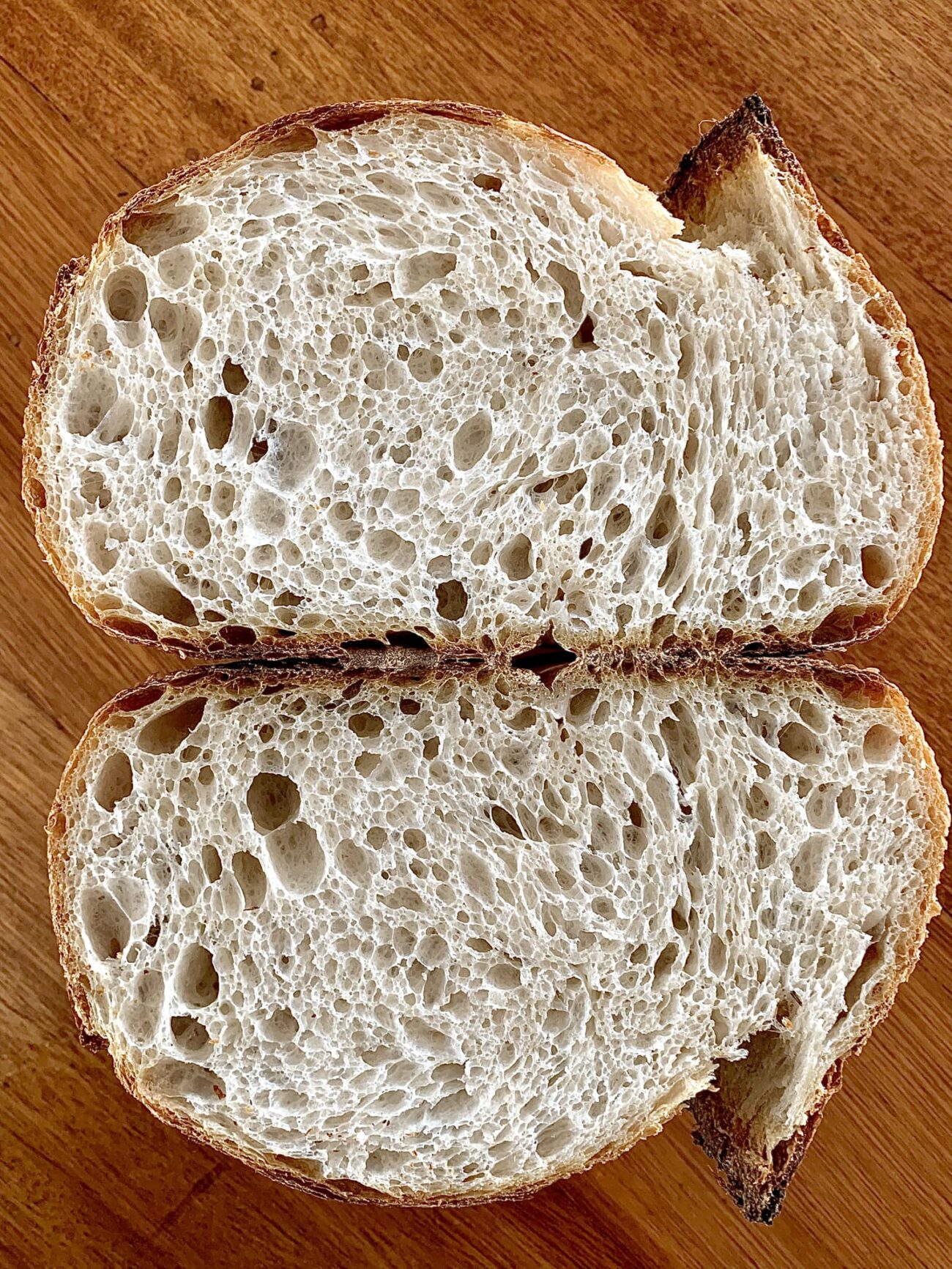
Achieving the “Lacy Crumb” with 80% Hydration & Lievito Madre
Most bakers chase “big holes,” but true masters chase an even, lacy, and open crumb—where the structure is so airy it’s cloud-like, yet strong enough to hold your favorite grass-fed butter. This recipe is a technical masterclass in fermentation integrity and dough strength.
I. The High-Performance Ingredient List
To achieve this specific texture, we use a custom four-flour blend. Each grain serves a mechanical purpose in the dough’s development.
The Flour Matrix (Total Flour: 420g):
- High-Protein Bread Flour (60% / 252g): The backbone. Provides the gluten strength needed to sustain a high rise.
- Fine Semolina (20% / 84g): The secret to a “velvety” crumb. It adds a subtle golden hue and incredible softness.
- Spelt Flour (10% / 42g): Boosts extensibility (stretch), making the dough easier to handle at high hydration.
- Whole Wheat (10% / 42g): Adds enzymatic activity and earthy complexity without weighing down the loaf.
The Hydration & Fermentation:
- Water (80% / 336g): Divided for the Bassinage technique (adding water in stages).
- Lievito Madre (20% / 84g): A stiff Italian starter. Pre-soak this in a portion of your water to soften it before mixing.
- Fine Sea Salt (2% / 9g): For flavor and to tighten the gluten network.
II. Technical Execution (Step-by-Step)
1. The Initial Incorporation (Autolyse)
Mix 100% of your flour blend with 75% of the water. Let it rest for 30–60 minutes. This “Autolyse” phase allows the flour to fully hydrate and kickstarts gluten development without any effort.
2. The Bassinage Technique
Add your softened Lievito Madre and salt. Begin mixing (a spiral mixer is preferred, but the Rubaud method works for hand-mixing). Gradually add the remaining 5% of water—this is the Bassinage. It allows the dough to accept high hydration while maintaining a silky, strong skin.
3. Bulk Fermentation & Structural Folds
Place the dough in a transparent bulk container at 77°F (25°C).
- Coil Folds: Apply one coil fold immediately, then another 30 minutes later.
- Fermentation: Let it ride for 5 hours total until the dough is puffy, jiggly, and filled with tiny gasses. You want to push fermentation to the max—look for a 50-60% increase in volume.
4. Shaping & The Cold Retard
- Pre-shape: Gently round the dough and rest for 1 hour at room temperature (75°F/24°C).
- Final Shape: Tension is key. Shape into a batard or boule and rest for another hour.
- Cold Cure: Place in the fridge at 37°F (3°C) for 14 hours. This long, cold sleep develops that signature sourdough tang and makes scoring easier.
5. The Bake
Score with a sharp lame. If using a Rofco or deck oven, bake at 392°F (200°C).
- Steam Phase: 20 minutes with heavy steam to allow maximum oven spring.
- Dry Phase: 20 minutes without steam to cure the crust into a deep, mahogany brown.
III. Masterclass FAQs (SEO Optimized)
Q: What is the benefit of using Lievito Madre over a liquid starter? A: Lievito Madre is a stiff, low-acid starter. It results in a milder, creamier flavor profile and a stronger vertical rise compared to a 100% hydration liquid starter, which can sometimes produce a more “sour” and acetic loaf.
Q: Why add Semolina to Sourdough? A: Semolina has a high protein content but different gluten properties. It helps create a “short” crumb that is incredibly tender to bite through, preventing the “rubbery” texture sometimes found in high-hydration loaves.
Q: My dough is too sticky to handle at 80% hydration. What should I do? A: This is where the Spelt and Bassinage come in. Spelt makes the dough more extensible (stretchy), and adding water slowly (Bassinage) ensures the gluten isn’t “drowned” early on. If you’re a beginner, drop the hydration to 72% and work your way up.
Q: How do I know if I’ve “pushed fermentation to the max”? A: The dough should feel like a marshmallow—extremely light and full of air, but still able to hold its shape when you tip it out of the banneton. If it puddles, you’ve over-fermented. If it feels dense, it’s under-fermented.
Q: Why use the Rofco oven at 200°C? A: Artisan bread thrives on consistent floor heat. The Rofco provides the stone-baked environment that mimics old-world European bakeries, ensuring a thick, caramelized crust and a fully gelatinized interior crumb.
IV. Crumb Assessment & Serving
When you slice into this loaf, you should see an even distribution of alveoli (the small air pockets). This is the hallmark of a perfectly fermented sourdough. Every single hole is visible, yet the structure remains sound.
The Elite Pairing: Because this bread features Fine Semolina and Spelt, it has a nutty, buttery undertone. It is best served slightly warm with salted cultured butter or dipped into a high-quality extra virgin olive oil.
